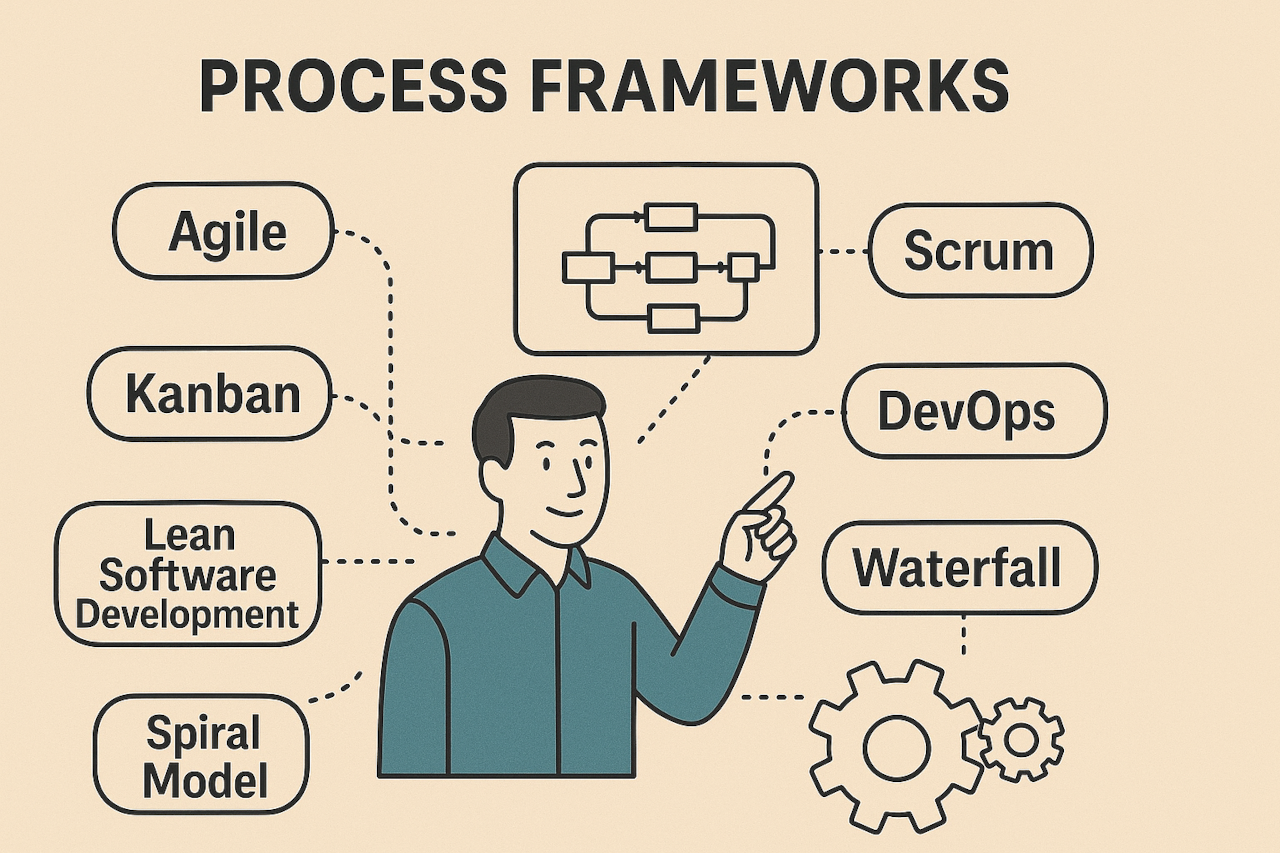
Development goes smoother when it follows a clear process framework, and to avoid confusion up front: this entry is strictly about methodology/process frameworks (how teams organize and deliver software), not programming or “code” frameworks like React, Django, or Spring. Process frameworks matter because they turn good intentions into repeatable habits. Without one, teams tend to improvise: requirements drift, priorities collide, and quality becomes subjective. A framework gives everyone the same map—how to plan, build, review, release, and learn. It reduces ambiguity (“what happens next?”), makes progress visible, and creates shared language between developers, designers, product leaders, and stakeholders. Most importantly, process frameworks lower risk by baking in checkpoints for security, performance, testing, and user feedback before problems become expensive. You still get creativity in the solution, but not chaos in the process.
These frameworks also scale collaboration. New hires ramp up faster because the workflow is documented and familiar. Teams estimate more accurately since work is broken into known shapes, sprints, stages, queues, or cycles and dependencies surface earlier. When incidents happen, frameworks help you diagnose where the system failed planning, execution, review, or deployment so you can strengthen the process instead of blaming individuals. Over time, that consistency compounds: delivery becomes steadier, stakeholders trust timelines more, and technical debt is managed rather than silently piling up.
Among the most popular process frameworks, you’ll see a few repeat across industries, each with strengths in different contexts:
-
Agile (umbrella philosophy): Emphasizes adaptability, incremental delivery, and frequent feedback, ideal when requirements evolve.
-
Scrum: A structured Agile method using time-boxed sprints, defined roles (Product Owner, Scrum Master, Dev Team), and ceremonies to drive alignment and predictable delivery.
-
Kanban: Focuses on visualizing work, limiting work-in-progress, and improving flow, great for steady incoming work or rapidly shifting priorities.
-
Lean Software Development: Targets waste reduction and maximizing customer value, helps teams avoid overbuilding and stay focused on outcomes.
-
DevOps (process/culture framework): Unifies development and operations with automation, CI/CD, and monitoring, shortens release cycles while improving reliability.
-
Waterfall: Sequential, phase-based delivery, useful when requirements are stable, scope is fixed, and compliance needs high upfront clarity.
-
Spiral Model: Iterative delivery with explicit risk assessment each cycle, best for large, high-risk projects.
-
V-Model: Links each development phase to a matching testing phase, common in safety-critical or regulated environments requiring strong verification.
Choosing a process framework isn’t about following rules for their own sake; it’s about picking the right constraints to help your team deliver better software with less friction. The best teams treat frameworks as living systems: they start with one that fits their context, measure how it’s working, and tune it over time. When you have that blend of structure, visibility, and continuous learning, development stops being a scramble and becomes a craft reliable, scalable, and focused on real value.
How Tecative can help: adopting or refining a process framework is easier when you’ve got experienced partners in your corner. Tecative works alongside teams to evaluate where you are today, recommend the framework (or hybrid) that fits your reality, and help implement it in a practical, lightweight way. Whether you’re trying to improve delivery predictability, reduce bottlenecks, modernize release practices, or build a healthier feedback loop with stakeholders, Tecative brings the tools, coaching, and hands-on support to get you there. The goal isn’t “process for process’ sake” it’s helping you ship better software, with less friction, and more confidence.
Comments (0)
No comments yet. Be the first to comment!












Leave a Comment