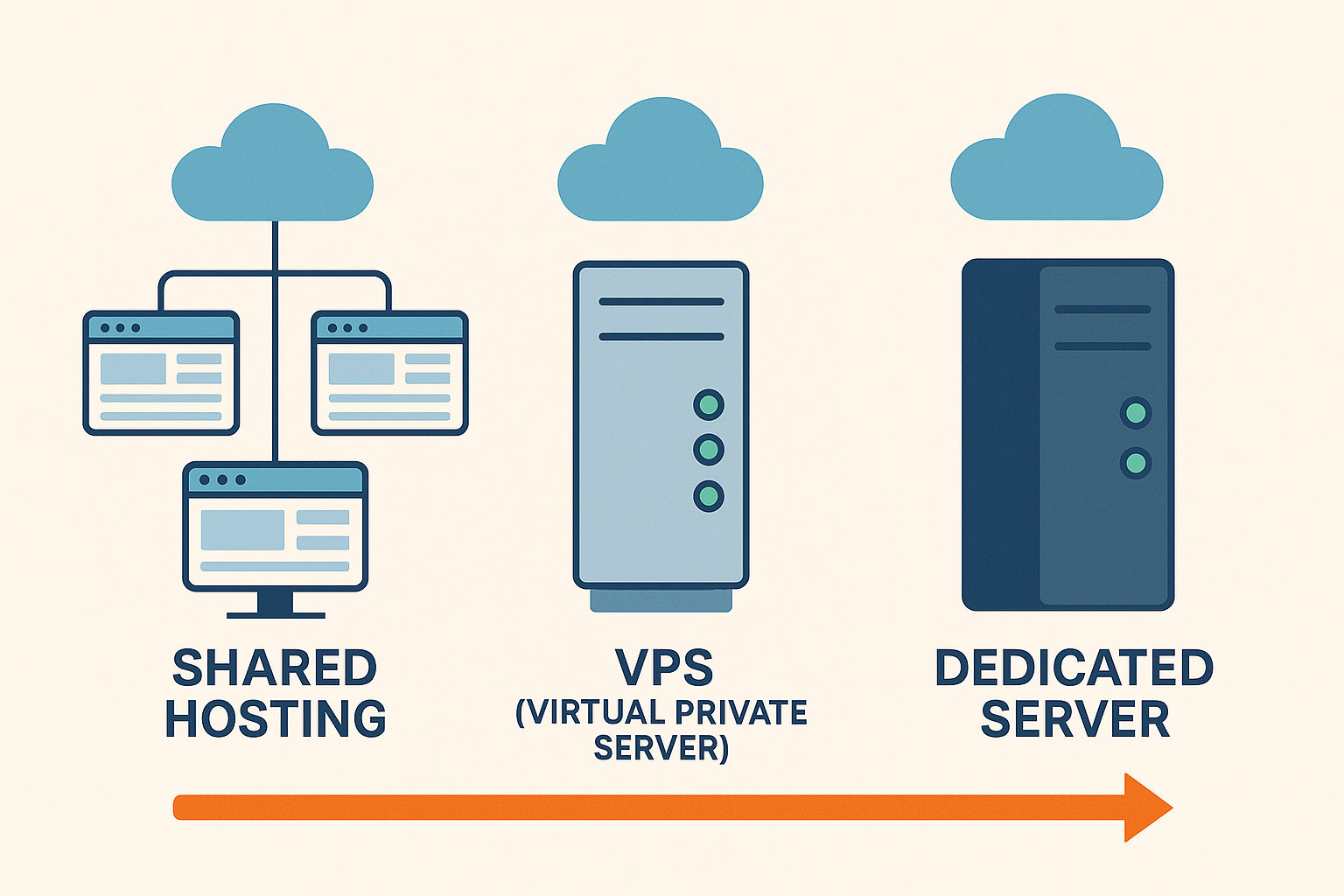
This generally refers to shared hosting, where multiple websites or users share the same physical server. The hosting provider manages everything, including hardware, software, maintenance, and security.
Good For:
- Small businesses, bloggers, and personal websites.
- People who want a low-cost solution with minimal technical expertise required.
- Ideal for sites that don’t have a lot of traffic or complex configurations.
Pros:
- Cheap: Most affordable option, typically the starting point for anyone building a website.
- Managed: Server maintenance, updates, and security are handled by the provider.
- Easy to use: No technical expertise required. Providers offer user-friendly control panels (e.g., cPanel) for managing sites.
Cons:
- Limited resources: Since many users are sharing the same server, resources (CPU, RAM) can be stretched thin during high traffic.
- Limited customization: You don’t have much control over the server setup, which could be a problem if your needs grow.
- Performance: If other sites on the server get a lot of traffic, your site’s performance may degrade.
- Security risks: Vulnerabilities on one website can affect others sharing the same server.
Best for:
- Individuals or small businesses with low to moderate traffic and simple hosting needs.
VPS (Virtual Private Server)
VPS is a middle ground between shared hosting and dedicated hosting. A VPS uses virtualization technology to divide a physical server into multiple virtual servers, each of which acts as its own independent machine. You still share the physical server, but each VPS has its own dedicated resources (RAM, CPU, etc.).
Good For:
- Small to medium businesses, e-commerce sites, or applications that need more control but don’t require a dedicated server.
- Developers and teams needing more configuration and performance than shared hosting.
Pros:
- More control: You have full access to your virtual server, so you can install custom software, change settings, and optimize performance as needed.
- Scalable: Resources can be upgraded more easily than on shared hosting, so you can grow as your traffic increases.
- Better performance: Since you get guaranteed resources (memory, CPU), your site is less likely to be affected by other users.
- Isolation: You are isolated from other VPS users, so their traffic doesn’t impact yours.
Cons:
- Requires technical knowledge: You might need to manage server configurations, software updates, and security patches yourself (unless you opt for managed VPS).
- Cost: More expensive than shared hosting, though cheaper than a dedicated server.
- Potential for resource over-allocation: VPS still relies on physical resources that could be over-allocated or shared with other VPSs, potentially leading to performance issues if the host doesn’t manage resources well.
Best for:
- Businesses with growing websites or applications that need more control, improved performance, and custom configurations without the full commitment of a dedicated server.
Dedicated Servers
A dedicated server means you have an entire physical server to yourself. You don’t share resources with anyone else, and you have full control over the hardware and software configuration.
Good For:
- High-traffic websites, large-scale applications, or businesses that need maximum control and performance.
- Organizations with specific needs for compliance, security, or high performance (e.g., gaming servers, data-intensive apps, etc.).
Pros:
- Full control: You have complete control over the server, including the ability to configure the OS, install custom software, and optimize performance.
- Maximized resources: Since you don’t share the server with anyone, all resources (CPU, RAM, disk space) are dedicated to you.
- Better security: No risk of other users affecting your server’s security. You can implement custom security measures suited to your needs.
- Highest performance: If you're running resource-heavy applications, databases, or sites, dedicated servers provide the best performance.
Cons:
- Expensive: This is the most expensive option and may be overkill for smaller businesses or projects.
- Requires technical expertise: You’ll need to know how to manage the server, install updates, troubleshoot issues, etc. Unless you choose a managed dedicated server, this can become a burden.
- Less flexibility (if unmanaged): Unlike VPS, you can’t easily resize resources. Adding more storage or RAM may require purchasing new hardware or even migrating to a new server.
Best for:
- Large enterprises, high-traffic websites, or businesses with complex requirements for customization, security, and performance.
- Websites with critical uptime needs or those that require special configurations, like dedicated game servers or data-intensive applications.
Summary Table
|
Feature |
Hosted (Shared) |
VPS (Virtual Private Server) |
Dedicated Server |
|
Price |
Cheapest |
Moderate |
Expensive |
|
Resources |
Shared (limited) |
Guaranteed resources (e.g., CPU, RAM) |
Fully dedicated resources (maximized) |
|
Customization |
Minimal |
High, but still limited by virtualized nature |
Full control over hardware & software |
|
Technical Skill |
Minimal (managed service) |
Moderate (requires some sysadmin knowledge) |
High (requires full server management) |
|
Scalability |
Low, limited by host server capacity |
Medium, can be upgraded within the VPS limits |
High, but requires server migration for upgrades |
|
Performance |
Shared, can be affected by other users |
Isolated, guaranteed resources, but not as powerful as dedicated |
Best performance, dedicated to your needs |
|
Security |
Low, risks from other users |
Better than shared, but still shared hardware |
Best, as you're isolated from other users |
When to Choose Each Service
- Shared Hosting (Hosted):
- When you have a small website, are just starting out, and don’t want to worry about managing the server.
- Great for personal blogs, portfolios, or small business websites that expect low traffic.
- VPS Hosting:
- When you need more control, flexibility, and resources than shared hosting, but can’t justify the cost of a dedicated server.
- Suitable for growing businesses or websites with moderate traffic that need customization and better performance than shared hosting can provide.
- Dedicated Hosting:
- When you need maximum control, security, and high performance for mission-critical applications or websites.
- Perfect for enterprise-level websites, large e-commerce sites, game servers, or data-heavy applications that require top-tier performance and reliability.
Choosing between shared, VPS, or dedicated hosting ultimately depends on your project’s size, performance needs, and technical experience. Each option has its strengths—and the right one can make all the difference in your website’s success.
If you’re unsure which type of hosting best fits your needs, Tecative is here to help. Our team can walk you through the options, answer any questions, and guide you toward the perfect hosting plan for your website or application.
Comments (0)
No comments yet. Be the first to comment!












Leave a Comment