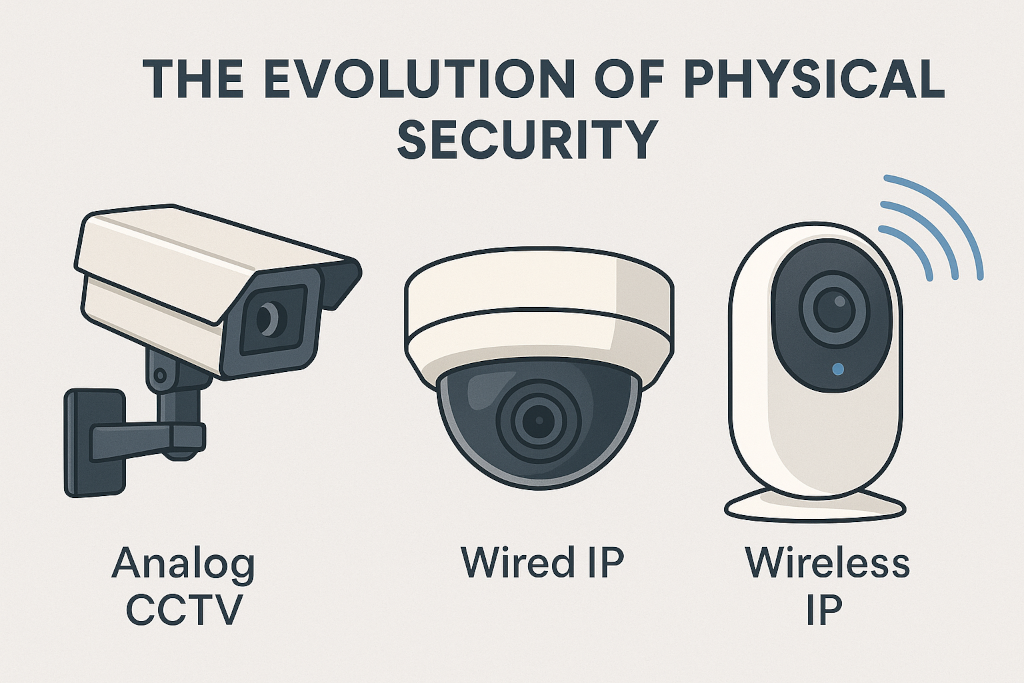
In today’s world, protecting your assets, people, and property is more important than ever. Whether you’re securing a small office, a retail store, or a large industrial facility, a reliable camera system is one of the most effective tools for ensuring safety. Over the years, camera technologies have evolved from basic analog CCTV systems to advanced networked surveillance solutions capable of real-time monitoring, analytics, and AI-powered detection.
When selecting the right surveillance setup, one key decision lies between CCTV, wired IP, and wireless systems. Each has unique advantages and limitations and understanding these differences will help you choose the best solution for your environment.
Types of Camera Systems
CCTV (Analog) Systems
CCTV (Closed-Circuit Television) systems have been the backbone of physical security for decades. They capture and transmit analog video signals through coaxial cables to a DVR (Digital Video Recorder), where footage is stored and viewed locally.
Pros:
- Proven reliability: CCTV systems are time-tested and consistent in performance.
- No internet dependency: They function without requiring a network connection, reducing vulnerability to cyber threats.
- Lower upfront cost: Analog cameras are typically more affordable than IP-based options.
Cons:
- Limited image quality: Analog systems generally offer lower resolution compared to modern IP cameras.
- Less flexibility: Remote access and smart integrations are minimal or nonexistent.
- Wiring limitations: Expanding or repositioning cameras can require significant rewiring.
Wired IP Camera Systems
Wired IP (Internet Protocol) cameras represent the next generation of surveillance. They connect directly to a network using Ethernet cables, transmitting digital video data that can be stored on an NVR (Network Video Recorder) or in the cloud.
Pros:
- High-resolution footage: Supports HD and 4K video for crystal-clear monitoring.
- Stable and secure: Wired connections eliminate signal dropouts and reduce hacking risks.
- Advanced features: Motion detection, AI analytics, and remote monitoring via apps or browsers.
- Power over Ethernet (PoE): A single cable can deliver both power and data, simplifying installation.
Cons:
- Complex installation: Running Ethernet cables can be labor-intensive, especially in older buildings.
- Limited mobility: Cameras are fixed unless you’re willing to rewire.
- Higher installation cost: Professional setup is often required.
Wireless Camera Systems
Wireless systems use Wi-Fi or cellular networks to transmit footage. These are ideal for flexible or temporary setups where running cables is impractical.
Pros:
- Quick and easy installation: Perfect for smaller spaces or DIY deployments.
- Flexible placement: Move cameras as needed without rewiring.
- Remote access: Seamlessly view footage and receive alerts through mobile apps.
- Modern design: Wireless systems blend easily into modern environments.
Cons:
- Signal interference: Performance can degrade if Wi-Fi coverage is weak or congested.
- Battery maintenance: Many wireless cameras rely on batteries that require recharging or replacement.
- Cybersecurity risks: Vulnerable to hacking if not properly secured.
- Variable video quality: Network congestion may impact image quality.
CCTV vs. Wired vs. Wireless: A Quick Comparison
|
Feature |
CCTV (Analog) |
Wired IP |
Wireless IP |
|
Video Quality |
Standard Definition |
High Definition / 4K |
HD / Variable |
|
Installation |
Moderate (Coax Cable) |
Complex (Ethernet Cabling) |
Easy (Wi-Fi Setup) |
|
Cost |
Low |
Medium to High |
Medium |
|
Remote Access |
Limited |
Full Network/Cloud Access |
Full Cloud Access |
|
Reliability |
High |
Very High |
Dependent on Wi-Fi |
|
Scalability |
Limited |
Excellent |
Good |
|
Maintenance |
Low |
Low |
Medium (Battery + Network) |
|
Security |
High (Physical) |
High (Encrypted) |
Moderate (Wi-Fi Dependent) |
Choosing the Right System for Your Needs
Selecting the right camera system depends on several factors:
- Small businesses and retail stores may prefer wireless systems for flexibility and quick setup.
- Large facilities or industrial sites often choose wired IP systems for reliability and scalability.
- Organizations with legacy infrastructure may still rely on CCTV systems but can consider upgrading to IP or hybrid solutions for future-proofing.
The Future of Security: AI, Cloud, and Integration
The next frontier of surveillance lies in AI-driven analytics and cloud connectivity. Cameras can now detect suspicious activity, count people, read license plates, and trigger alerts automatically transforming passive monitoring into proactive security management.
Partner with Tecative for Your Security Needs
Whether you’re setting up a small-scale surveillance system or managing a large, multi-site deployment, Tecative is here to help.
We specialize in designing and implementing end-to-end physical security solutions from traditional CCTV installations to advanced IP and wireless systems. Our experts ensure your setup is reliable, secure, and tailored to your specific operational needs.
With Tecative, you don’t just get technology you get a trusted partner committed to protecting what matters most.
Final Thoughts
The choice between CCTV, wired, and wireless systems depends on your environment, budget, and long-term goals. While CCTV remains a dependable option, IP and wireless technologies offer enhanced features, scalability, and remote access — making them ideal for modern security strategies.
No matter which system fits your needs, Tecative ensures your investment delivers peace of mind, performance, and protection.
Comments (0)
No comments yet. Be the first to comment!












Leave a Comment